Wednesday, April 14, 2021

"New lives for Bulgaria's abandoned children", article in BBC News, dated October 15, 2009

Source:

New lives for Bulgaria's abandoned children, article and photographs by Kate Blewett, in BBC News (Europe) on 15 October 2009


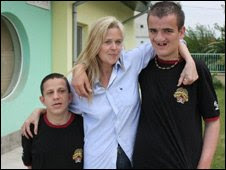
Above: Bulgaria has the highest number of disabled children in institutes in the EU. (Milen and Misho now live in a small home with other young people of mixed abilities.


Above: Didi now goes to school every day and is top of her maths class.


Above: Vasky was suffering from malnutrition and neglect but is now much happier.

The article:

New lives for Bulgaria's abandoned children

Award-winning documentary filmmaker Kate Blewett recently returned to Bulgaria to see how things have changed after the international outcry in response to her film Bulgaria's Abandoned Children.

In the original film, which I made two years ago, I focused on a handful of the 75 disabled children living in the Mogilino institute and watched their lives over a nine-month period. I witnessed their dreadful deterioration.

My first impressions of Mogilino were strangely misleading because the actual building was clean, bleached and painted.

It was not until I pulled back the bed covers to witness the children's wasted bodies that I realised there was a very serious problem.

Vasky is blind and suffers with cerebral palsy. She was abandoned in a baby unit and then sent to Mogilino at the age of four, where she grew up. We learnt that when she arrived she loved music, and loved to dance and sing.

Sadly what I witnessed, 14 years after her arrival, was a deeply unhappy girl, who had simply shut down, who sat on her bed day in and day out — saying nothing, her head bent down between her knees.

Brutalised

Milen, a gentle teenager with a cleft palate and the mentality of a young child, is mute and spent each day helping out around the home. Now 21, he does not speak because no-one has bothered to talk to him.

During filming, Milen was brutalised and beaten by a member of the staff. I captured this on camera and confronted the director of Mogilino.

The offending staff member was fired and Milen was moved to a protected home far away.

Didi, now 20, arrived at Mogilino just before filming began. Her mother could no longer cope with her teenage daughter's autism at home, so she abandoned her to the institute.

Sadly for Didi, she was thrown into an environment where she could not make any friends or continue with her education, because Mogilino is a place for the uneducable and those living there do not speak.

Didi deteriorated rapidly and would rock back and forth relentlessly. She shut down — just like all the others around her.

Extraordinary impact

To witness such human deterioration and to know the only way to truly effect change was to carry on filming and bring the documentary film to a wider audience — was an incredibly difficult process.

However the impact my film had has been extraordinary. Viewers wrote to me by the thousands, donating money, and forming petitions demanding change from their MPs and MEPs.

Some gave up their jobs and went to Bulgaria to help, taking supplies, food, clothing and medical aid.

The Bulgarian government put Unicef in charge of finding new placements for all the children of Mogilino, with the plan that the institute will shut once every child has been re-housed.

Slavka Kukova, co-ordinator of the Protection of the Institutionalised Children's Human Rights Program, says that the film meant that disabled children's "rights and problems are now on the agenda for the Bulgaria media."

"A slow process of raising awareness about the potential reform of the children care system has now started," she adds.

This year I returned to Bulgaria to find out exactly what has happened to some of the key characters from the original film. Once again I was shocked by what I found.

I witnessed the miraculous improvements that can happen in badly-damaged children when decent care is finally given to them.

Milen now lives in a glorious home with seven other young people and good carers. He is a new person — happy, outgoing and communicative through sign language.

He works every day putting handles onto bags and is paid for the amount he completes. He attends a day-care centre where he creates art and plays games with the other young people.

Genuine care

Didi lives in a special boarding school for those with behavioural and learning difficulties. She has wonderful carers and has made good friends.

She goes to school every day and is top of her maths class.

She makes her own clothes, goes to the shops to buy things she likes and visits museums and art galleries.

Vasky has been moved to an institute for the blind, which though large has excellent care and she has been transformed into a happy, active, smiling young lady.

She eats well and demands two courses at meal times, giggling cheekily with her carer as she asks if she can go out in her car with her.

A report from Unicef also recognised that the children from Mogilino have made great improvements since leaving the home.

"Their cognitive development has changed at all levels (perception, attention, memory and thinking) ... they have become part of particular groups and spend more time playing."

I feel overwhelmed with the dramatic changes in the lives of these young people. I feel the film lifted the lid on a desperate situation that had been hidden away.

I look forward to the day this year when Mogilino is finally shut.

The problems were not all about poverty or money, but rather about having a good level of genuine care that transformed a miserable existence into a fulfilling one.

Bulgaria does have good carers and decent homes but what it now needs to do is to get rid of its large, isolated institutes that are warehouses to a further 8,000 disabled children, and to create small group homes.

"There can be no more remodelling or restructuring of institutions. There needs to be a well-organised campaign that seeks to close down all institutions and set up proper alternative care services," says Mark O'Sullivan of the Bulgarian-based Cedar Foundation.

"The government needs to carry on what it is doing well but it also needs to radically overhaul the parts of its system which are not working," he adds.

All members of the EU should draw Bulgaria in as a new family member and help turn around the care system for the abandoned disabled children, to deinstitutionalise a country that has a new receptive government in place — and is ready for change.

Bulgaria's Abandoned Children Revisited is on BBC Four on Thursday 15 October at 2100 BST.

"The state acknowledged that the home in Mogilino did not meet care standards", article in Mediapool News, from March 5, 2008

Source:

"Държавата призна, че домът в Могилино не отговаря на стандартите за грижи", article in Mediapool News, 5 March 2008


The article:

Държавата призна, че домът в Могилино не отговаря на стандартите за грижи
05 март 2008

Проверка в дома за деца с умствени и физически увреждания в русенското село Могилино, извършена от служители на Държавната агенция за младежта и спорта (ДАМС) по нареждане на Върховната касационна прокуратура (ВКП), е установила, че домът отговаря само на един от 26-те стандарта за отглеждане на такива деца. Това съобщи началникът на дирекция Бистра Петрова пред парламентарната комисия по въпросите за децата, младежта и спорта.

Така държавата призна, че грижите в дома, добил скандална известност не само у нас, но и в Европа покрай филма на ББС “Отхвърлените деца на България”, не отговарят на съвременните изисквания. Преди това обаче всички възможни държавни институции хвърлиха огромни усилия да опровергават авторите на филма, който показваше как децата в този дом влошават състоянието си именно от липсата на адекватно отглеждане.

Проверката е завършила с категоричното становище, че домът в Могилино трябва да се закрие заедно с останалите 6 подобни заведения.

Оттук насетне заседанието на парламентарната комисия зацикли в познати тези о неефективни решения. Така председателят на комисията Васил Иванов — Лучано предложи да бъде сформирана междуведомствена контактна група, която да работи по дейността на всички социални домове в страната. Според предложението му в групата ще влязат представители на Министерството на правосъдието, на финансите, на труда и социалната политика, на образованието, на здравеопазването, на Държавната агенция за закрила на детето, Агенцията за социално подпомагане, Националното сдружение на общините, както и на Държавната агенция за младежта и спорта. Гласуването на това предположение обаче остана за следващото заседание на комисията.

Директорката на дома Павлина Йорданова обяви пред депутатите, че извършеният медицински преглед на децата е показал, че част от тях не биха могли да се адаптират, ако бъдат изведени от досегашната им среда. Тя призова поне някои от децата да останат за отглеждане в дома, и ако се налага, той да бъде преобразуван в "малък групов дом".

Кметът на село Могилино Димитър Димитров заяви пред комисията, че материална база в дома отговаряла на всички изисквания. Кметът повтори пред журналисти страха си, че 60-те души от селото, които за заети в дома, ще останат без работа.

Секретарят на община Русе Валентин Христов пък помоли депутатите да не прибързват със затварянето на дома в Могилино и с преместването на децата в община Русе, защото това щяло да бъде само "географско решение на проблема, който касаел предимно тяхното обгрижване."

Община Русе била готова за предостави терен, но напрежението в квартал "Средна кула" избухнало именно заради прибързаното обявяване закриването на дома, каза още Христов. По думите му, едно евентуално преместване на децата от Могилино в община Русе ще бъде вредно за тях заради враждебната среда, в която ще попаднат. А от квартала някои хора реагираха на новината за евентуално преместване на увредените деца в защитени жилища с довода, че питомците щели да стресират техните деца.

English translation (my own):

The state acknowledged that the home in Mogilino did not meet care standards
March 05, 2008

An inspection of the home for children with mental and physical disabilities in the Ruse village of Mogilino, carried out by employees of the State Agency for Youth and Sports (SAYS) on the orders of the Supreme Cassation Prosecutor's Office (SCP), found that the home met only one of the 26 standards of caring for such children. This was announced by the head of the directorate Bistra Petrova before the parliamentary committee on children, youth and sports.

Thus, the state acknowledged that the care at the home, which gained notoriety not only in our country but also in Europe along with the BBC film "Bulgaria's Abandoned Children", does not meet modern requirements. Before that, however, all possible state institutions made great efforts to refute the authors of the film, which showed how the children in this home worsen in their condition precisely because of the lack of adequate care.

The inspection ended with the categorical opinion that the home in Mogilino should be closed together, with 6 other similar establishments.

Henceforth, the sitting of the parliamentary committee became entrenched in ineffective decisions. Thus, the chairman of the commission, Vasil Ivanov-Luciano, proposed to form an interdepartmental contact group to work on the activities of all social homes in the country. According to his proposal, the group will include representatives of the Ministry of Justice, Finance, Labour and Social Policy, Education, Health, the State Agency for Child Protection, the Social Assistance Agency, the National Association of Municipalities and the State Agency for Youth and Sports. However, the vote on this assumption remained for the next committee meeting.

The director of the home, Pavlina Yordanova, told the deputies that the medical examination of the children showed that some of them could not adapt if they were taken out of their current environment. She called for at least some of the children to stay in the home and, if necessary, it be converted into a "small group home".

The mayor of the village of Mogilino, Dimitar Dimitrov, told the commission that the material base in the home met all the requirements. The mayor reiterated to journalists his fear that the 60 people from the village who are employed in the home will lose their jobs.

The secretary of the municipality of Ruse, Valentin Hristov, asked the deputies not to rush with the closing of the home in Mogilino and the relocation of the children in the municipality of Ruse, because this would be only "a geographical solution to the problem, which mainly concerned their care."

The municipality of Ruse was ready to provide land, but the tension in the Sredna Kula neighborhood erupted precisely because of the hasty announcement of the closure of the home, Hristov added. According to him, a possible relocation of the children from Mogilino to the municipality of Ruse will be harmful for them because of the hostile environment in which they will find themselves. And some people in the neighborhood reacted to the news of the possible relocation of disabled children to sheltered housing, arguing that the little ones would stress their children.

"Mental health travesty in Bulgaria", article in BBC News, dated December 16, 2002

Source:

Mental health travesty in Bulgaria, article by Karen Allen (BBC Health Correspondent) in BBC News, dated 16 December 2002


Above: Patients have to cope with the intense cold.


Above: Conditions are squalid.

The article:

Mental health travesty in Bulgaria
By Karen Allen
BBC Health Correspondent

As Bulgaria looks set to join the European Union by 2007, it is under pressure to reform mental health care — in particular its notorious social care homes.

These are not psychiatric hospitals but institutions for people with mental disabilities.

People who in many other parts of Europe would be cared for in the community.

They are very much a hangover from Soviet times, more akin to Russian labour camps then [sic] sanctuaries of care.

In many instances there is barely any heating although there are sub-zero temperatures outside and the glass from the windows is missing.

There is minimal medical attention (in many homes there is no doctor on site) and nutritious food is in limited supply.

It is perhaps not surprising when those running the homes have a budget of around £30 per person per month.

Widespread ignorance

What makes it all the more worrying is that many people in Bulgaria aren't aware these places exist — so the political pressure to close them down comes largely from independent monitoring groups which have so far only had limited success.

According to the Bulgarian Helsinki Committee — an internationally respected human rights group — Bulgaria has some 100 social care homes — responsible for around eight thousand vulnerable adults and children.

These people have been abandoned by their families — often since childhood — a throwback to the Communist past when the cultural norm was to hide these people away in institutions far away from view.

Many countries are guilty of doing the same to a lesser degree but the difference with Bulgaria is the neglectful state of these human warehouses.

Guardianship of the residents rests with the directors of the homes and once a mentally ill person has been admitted, there is little chance they will get out.

There is also little incentive to close the homes down when in many cases they're the main employer in the district.

Mountain unit

I visited one in Western Bulgaria — Pastra situated high up in the mountains not far from the Rila Monestary [sic], one of the most religious spots in Bulgaria.

But there is nothing spiritual about Pastra. Here men with mental disabilities ranging from severe schizophrenia to what we in the UK would call "learning disabilities"; pace aimlessly around in the snow.

Some have no shoes and socks although it's minus ten degrees outside.

One in ten residents did not survive the past year — and there is no reason to expect it to be any different this year.

All this in 21st century Bulgaria. A country rich in history, religion and culture soon to become a fully fledged member of the European Union.

A country which has met the Copenhagen Criteria which states that "membership requires that the candidate country has achieved stability of institutions guaranteeing democracy, the rule of law, human rights and respect for, and protection of minorities", and a country that has been slow to right the wrongs of the past.

Bulgaria is struggling economically so money is tight.

Reforms in mental health care are in the pipeline — but the focus is largely on practices in psychiatric hospitals (themselves appaulling [sic]) — and to date social care homes seems [sic] to have been excluded from any proposals.

International standing

Even so, the Ministry of Labour and Social Policy is sensitive to its international reputation and has told the BBC that its investment is going into modernising these homes.

It trumpets the fact that it has put more money into modernising it's [sic] social institutions and has closed the notorious Sanadinovo children's home.

But when a ministry tells you that at Pastra the heating problems were solved two years ago — and our visit proved that this was clearly no[t] so — one has to be sceptical about how much things have changed.

Human Rights Campaigner Krassimir Kanev sums up the situation.

"Bulgaria strives to reach the European level of economic and social welfare and on the other hand it has 18th century asylums."

Of course, Bulgaria is not alone in continuing the practices of the past.

Romania and Hungary have also had attracted criticism for the atrocious state of their mental health instututions [sic].

But pressure must be brought to bear by the international community.

The fact that a recent report by Amnesty International on the state of Bulgaria's care homes, received barely any press or media coverage — is an indictment of a modern society that has forgotten that it was only 13 years ago, when similar scenes of neglect in Ceaucescu's Romania, caused a global outcry.

"To be raised in a family is an undeniable right for every child: Challenges of Children in Residential Centers", article from UNICEF Albania from November 6, 2019

Source:

"To be raised in a family is an undeniable right for every child: Challenges of Children in Residential Centers", article written by Klodiana Kapo for UNICEF Albania, 6 November 2019


The article:

There is silence in the room. Only Miri can be heard, seeking for his mother. No one answers. A woman with a white apron comes to his side, but she is not the mother, she is the caregiver of the orphanage who takes care of Andi and Miri. In only six months, their lives have completely changed. The two brothers lived on the outskirts of a coastal town in Albania. Life seemed normal, until one day, Flutura, the mother, had left the apartment with her daughter because her husband repeatedly abused her. But now, he is in prison. The only person who can take care of the boys is Agimi, the grandfather.

He is old, with no financial means, and after two months of trying hard to take care of the two little boys, he has given up. He asked the municipality for support, stating that he is unable to care for his grandchildren and asked that the children be placed under the care of the state authorities. Immediately, the municipal employee opened a file, assessed the conditions and registered the case. It was immediately decided that both children be accommodated in a residential care institution.

He returned home, and his heart was pounding out of his chest as he thought about his grandchildren who would no longer be in his home. He knew that, despite the dedication of the caregivers, they cannot replace the warmth of the family that the boys need so much. Since then, it has been a long time in the center, and it's not known what their future will be like. Flutura, the mother, can't take the kids with her, she can't go back home and has no stable income to care for her three children.

Challenges of Children in Residential Centers

Children who are part of residential care institutions are deprived of social, emotional and intellectual stimulation, which are critical to the healthy development of a child's brain. Distanced from mainstream society, children in institutions are particularly vulnerable to violence, neglect and, abuse. Experts affirm that the impact of child separation and institutionalization is severe and can last a lifetime.

The law states that the highest interest of children is not to remain in institutional care, but rather with their biological family. Currently, in Albania, 230 children live in public residential care facilities, however, most of them have biological families. Miri and Andi will continue to stay in the Institution. The time span of the parents' parental training depends on their interest, but also on the commitment of the social service structures to empower the family with a full package of services.

In the case of two children, their family is not yet ready to care for them, their father is still in prison. Flutura, their mother, continues to be afraid, because her husband could get out of jail and endanger both her and her daughter's life.

The way to the solution

For the first time, professionals from the Ministry of Health and Social Protection in Albania and UNICEF have developed an assessment of children and their families, for every child placed in institutional care. Experts have observed and are proposing options for the reunification of children with their biological families. Even when children have to leave their families to be more safe, other forms of care have to be found to recreate the family environment, such as foster families.

With the support of UNICEF and the Ministry of Health and Social Welfar[e], special teams of experts have been set up to assess the needs of children in institutional care. Work is underway with local government and residential care institutions to design and implement child development and family empowerment support programs. This team will also support each of the 231 children in six Public Care Institutions with the necessary services for their development and well[-]being until they are given opportunities to grow up in a family environment, because children like Miri and Andi deserve to grow up like all other kids.

Sunday, January 31, 2021

"The social home in the village of Pastra", article in bTV News, dated December 7, 2003

Source:

Социалният дом в село Пастра (The social home in the village of Pastra), article written by Kristina Baksanova in bTV News, 7 December 2003


The article:

Социалният дом в село Пастра

Условията на живот в институции за хора с психически увреждания са тежки, а възможностите за рехабилитация и лечение - оскъдни. Това е записано в годишния доклад на Европейската комисия за страната ни.

7 декември 2003

автор: Кристина Баксанова

С лудите, ние здравите или се шегуваме, или отвръщаме уплашено глава, когато минат покрай нас на улицата. И е най-лесно да отсъдим, че някой е причинил на някого нещо, защото е луд и мястото му е в лудницата. Защо в България "лудницата" е по-страшна от "затвора"?! Какво причиняваме ние, здравите, на тях, лудите. И с какво ги подлудяваме?

Болницата
"Лудницата" - с това второ име бележат местните хора благоевградското село Хърсово. То е в планината, на десетина километра от града. В Хърсово са на лечение заедно мъже и жени. Шестима от тях са тук вече повече от три години. В болницата можеш да поиграеш... Или да попееш... Да сготвиш или да си купиш кола от барчето за 10 стотинки. Да помогнеш... Или да се влюбиш...

Домът
"Страх ли ви е от тях?" - с тези думи ни посрещнаха в дома за възрастни мъже с психични разстройства в село Пастра. До дома няма шосе, нито табела. Скрит е в Рилската обител. За да стигнете до него, трябва да се отклоните около 3 километра от пътя за Рилския манастир. Това не е лудница. Това е дом. В него живеят мъже, които са боледували от психични разстройства, но според медицинския термин сега са в ремисия. Това означава, че тези мъже всеки ден пият лекарства, за да се възстановяват напълно, не са в криза и съзнанието им е като на здрав човек. Повечето от пациентите са настанени в дома по искане на роднините им. И остават тук забравени завинаги.

Сред тях има и от наричаните "нормални". Като Асен. Той е настанен по искане на роднините му. "Аз съм от две години тука, в дома. Две години седях, един месец си бях в къщи и сега пак влезнах. Дойдохме в четвъртък с батко за подпис за лекарствата. Аз се забавих, защото ми стана лошо, а те са си заминали и аз останах", разказва Асен.

Според правния термин Асен е под "запрещение" - т. е. мъжът има роднина, който решава вместо него.
"Ако роднина или настойник не иска или не може да се справя с грижите за един психично болен, той може да бъде настанен в институция. Законът за социално подпомагане изисква това да се прави, когато са положени всички усилия, грижите за тези хора да се полагат в общността", обясни София Разбойникова от "Български адвокато за правата на човека".

В Пастра Асен не общува с никого, както повечето мъже в дома. Предпочита да е сам. Непрекъснато пита санитаря кога ще го пусне да се върне при роднините си в къщи.
- Да си живея при тях искам — казва Асен.
- Тук какво не ви харесва?
- Ами обстановката, чувствам се подтиснат.

Стаята на Асен е на последния етаж в една от сградите. "Стаите са хубави, не са лоши, но няма стъкло. Нощно време е студено, осветление няма", обяснява Асен. Не се налага мъжете да гасят лампата. Когато вали, усещат дъжда по лицето си, докато лежат в леглата. Тоалетната и банята са навън.

"В повечето домове няма материални условия тези грижи да бъдат полагани. Рядко за тях се полагат редовни грижи от лекари, редовни прегледи от стоматолог, гинеколог и т. н.", посочи София Разбойникова, адвокат по правата на човека.

За мъжете в Пастра се грижи общо практикуващ доктор. Психиатър няма. Само в два пъти в годината са преглеждани от такъв специалист. Директорът на дома Асен Косанов не е лекар, а санитар. "Тук са настанени пациентите, които не са в остър стадий на болестта и не се лекуват в болници. Тук са на поддържаща терапия", казва Асен Косанов.
- Могат ли да живят в града?
- Да, но не можем да сме сигурни, че няма да реагират по начин, който е опасен за околните.
- Например?
- Например, някои обичат да палят, някои да буйстват.

Още преди две години български и международни правозащитни организации сигнализираха, че условията в тези домове са опасни за здравето на обитаващите ги. В последния доклад на Европейската комисия е записано, че в България животът в институциите за хора с психически увреждания е тежки и неадекватен, а рехабилитацията и лечението - оскъдни.

"Има установени случаи на насилие, дори има установени случаи на смърт, поради недохранване и измръзване, които не се разследват, а това е задължение на българската държава", съобщи Разбойникова.

В дома в Пастра има около 90 пациенти и 36 души персонал. Шепнейки, работещите споделиха, че между тези мъже има математик, инженер, няколко учители и филолози. Никой от мъжете не посмя сам да ни заговори, все едно в дома нямаше непознати.
- Какво правят мъжете през деня?
- Най-често се пекат на слънце, когато времето позволява. 10-15 човека помагат на хората в съседното село, но основната част седят — отговори Асен Косанов.

В Пастра Асен трябва да се чувства като у дома си, но очите му остават помръкнали, а устните му прошепват само една молба: "Ако могат да ме пуснат да си ходя, да си отида от тук, завинаги!"

Центърът
Центърът за психично здраве "Адаптация" се намира в къща, в центъра на София. Готвачите в кухнята са "клиенти" на центъра. Това са хора с психични проблеми, които също са в ремисия като обитателите на дома в село Пастра. Те могат да избират как да прекарват част от свободното си време - например да напазаруват, или да приготвят вкусно ястие, да разговарят на чаша чай или кафе, да поспорят или да измайсторят нещо в групата по арт терапия. Всеки от тях идва в центъра след разговор с психиатър, психолог или личния си лекар.

Николета избира група по готварство. Тя разказва: "Аз останах съвсем сама, без работа, без семейство, без майка и дойдох тук, за да намеря една социална среда. Тук се срещам с хора с моето заболяване и сме много толерантни един към друг. По-голямо разбиране намирам, по-спокойна се чувствам."

"Като дойдем сутринта, всички се събираме и решаваме какво да сготвим. Даже вчера решили пълнени чушки, но чушките не са хубави и решихме да направим миш-маш", обяснява възрастна жена.

Програмата съществува от две години. През първата година парите отпуска неправителствена организация. Сега участниците продължават да идват в кухнята и всеки сам заделя по 50 стотинки или левче, за да купят продуктите. "Планираме горе-долу определена цена и купуваме. Важното е, че се събираме тук и сме заедно. Заедно си хапваме. Ние можем и вкъщи да си сготвим, но тук сме заедно и ни е по-весело, по не се чувстваме изолирани", сподели Николета.

Дневният център е един от моделите за грижи на хората с психични проблеми в общността - близо до домовете и семейства им.
- За какво си говорите най-често?
- Говорим си най-често какво ще сготвим. Но понякога и се оплакваме, на кой какво се е случило. Това, което другите хора не могат да го понесат, ние го понасяме. Нещо като групова терапия — отговаря Николета.

"Преди сме седмици Елена имаше рожден ден. Направихме торта, супа, пуснахме си музика, танцувахме. При нас няма никакъв хаос, както си мислят някои. При нас има по-голям ред, отколкото в обществото. И никой не крещи и не вика", обясни Николета.

И следващата седмица тя пак ще се среща с новите си приятели в центъра ще се чувства полезна: "Тук нямам шеф, който да ме травмира и да ми крещи. По-добре се чувствам - все едно си ходя на работа, но без шеф."

Трябва да има повече подобни дневни центрове за хора с психични проблеми е записано в бялата книга за здравното министерство за реформата на психиатричната помощ в страната ни. Засега малкото съществуващи подобни дневни центрове са подкрепяни само от неправителствени организации.

English translation (my own):

The social home in the village of Pastra

Living conditions in institutions for people with mental disabilities are difficult, and opportunities for rehabilitation and treatment are scarce. This is written in the annual report of the European Commission for our country.

December 7, 2003

author: Kristina Baksanova

With the insane, we, the healthy, either joke or turn our heads in fright when they pass us on the street. And it's easiest to judge that someone has done something to someone because they're crazy and their place is in the madhouse. Why in Bulgaria is the "madhouse" scarier than "prison"?! What do we, the healthy, do to them, the insane? And what do we drive them insane with?

The hospital
"The Madhouse" — with this middle name the locals mark the Blagoevgrad village of Harsovo. It is in the mountains, ten kilometers from the city. In Harsovo, men and women are being treated together. Six of them have been here for more than three years. In the hospital you can play... Or sing... Cook or buy a car from the bar for 10 stotinki. Help... Or fall in love...

The home
"Are you afraid of them?" — with these words we were greeted at the home for elderly men with mental disorders in the village of Pastra. There is no road or sign to the house. It is hidden in the Rila Monastery. To reach it, you have to deviate about 3 kilometers from the road to the Rila Monastery. This is not a madhouse. This is a home. It is inhabited by men who have suffered from mental disorders, but according to medical terms are now in remission. This means that these men take medication every day to fully recover, are not in crisis and their mind is like a healthy person. Most of the patients were placed in the home at the request of their relatives. And they remain forgotten here forever.

Among them are the so-called "normal" ones. Like Asen. He was accommodated at the request of his relatives. "I've been here for two years. I've been sitting here for two years, I've been home for a month and now I'm in again. We came on Thursday with my dad to sign the drugs. I was late because I felt sick and they left and I stayed", says Asen.

According to the legal term, Asen is under "interdiction" — i.e. the man has a relative who decides instead.

"If a relative or guardian does not want or cannot cope with the care of a mentally ill person, he or she can be placed in an institution. The Social Assistance Act requires this to be done when all efforts have been made to care for these people and put them in the community", explained Sofia Razboynikova, a Bulgarian human rights lawyer.

In Pastra Asen does not communicate with anyone, like most men in the home. He prefers to be alone. He constantly asks the nurse when he will be allowed to return home to his relatives.

"I want to live with them," says Asen.

"What don't you like here?"

"Well, the situation, I feel depressed."

Asen's room is on the top floor of one of the buildings. "The rooms are nice, not bad, but there is no glass. The nighttime is cold, there is no lighting," explains Asen. Men do not have to turn off the lamp. When it rains, they feel the rain on their faces as they lie in bed. The toilet and bathroom are outside.

"In most homes there are no material conditions for this care to be provided. They are rarely provided with regular care by doctors, regular check-ups by a dentist, gynecologist, etc.," said Sofia Razboynikova, a human rights lawyer.

The men in Pastra are cared for by a general practitioner. There is no psychiatrist. Only twice a year are they examined by such a specialist. The director of the home, Asen Kosanov, is not a doctor, but a nurse. "Patients who are not in the acute stage of the disease and are not treated in hospitals are accommodated here. They are on maintenance therapy here," says Asen Kosanov.

"Can they live in the city?"

"Yes, but we can't be sure that they will not react in a way that is dangerous to others."

"For example?"

"For example, some like to light fire, some like to riot."

Two years ago, Bulgarian and international human rights organisations signaled that the conditions in these homes were dangerous to the health of their occupants. The latest report of the European Commission states that in Bulgaria life in institutions for people with mental disabilities is difficult and inadequate, and rehabilitation and treatment are scarce.

"There are established cases of violence, there are even established cases of death due to malnutrition and frostbite, which are not being investigated, and this is an obligation of the Bulgarian state," Razboynikova said.

The home in Pastra has about 90 patients and 36 staff. Whispering, the workers said that among these men there was a mathematician, an engineer, several teachers and philologists. None of the men dared to speak to us alone, as if there were no strangers in the house.

"What do the men do during the day?"

"Most often get they baked in the sun when the weather allows. 10-15 people help the people in the neighboring village, but the main part is them just sitting", answered Asen Kosanov.

In Pastra, Asen tries to feel at home, but his eyes remain dark and his lips whisper only one plea: "If they can let me go, let me go from here, forever!"

The center
The "Adaptation" Mental Health Center is located in a house in the center of Sofia. The chefs in the kitchen are "customers" of the center. These are people with mental health problems who are also in remission like the residents of the home in the village of Pastra. They can choose how to spend part of their free time — for example, shopping, or preparing a delicious meal, talking over a cup of tea or coffee, arguing or doing something in the art therapy group. Each of them comes to the center after a conversation with a psychiatrist, psychologist or personal doctor.

Nikoleta chooses a cooking group. She says: "I was left completely alone, without a job, without a family, without a mother and I came here to find a social environment. Here I meet people with my illness and we are very tolerant of each other. I find a greater understanding, I feel calmer."

"When we come in the morning, we all get together and decide what to cook. Just yesterday we decided on stuffed peppers, but the peppers are not good and we decided to make mish-mash," explains an elderly woman.

The program has existed for two years. In the first year, the money was provided by a non-governmental organisation. Now the participants continue to come to the kitchen and each of them sets aside 50 stotinki or a levche to buy the products. "We plan a certain price and buy. The important thing is that we gather here and are together. We eat together. We can also cook at home, but here we are together and we have more fun, we don't feel isolated" , shared Nikoleta.

The day center is one of the models for caring for people with mental health problems in the community — close to their homes and families.

"What do you talk about most often?"

"We often talk about what we will cook. But sometimes we complain about what happened to whom. What other people can't stand, we put up with. Something like group therapy", Nicoleta answers.

"Weeks ago, Elena had a birthday. We made a cake, soup, played music, danced. There is no chaos with us, as some think. We have more order than in society. And no one screams or shouts", explained Nikoleta.

And next week she will meet her new friends at the center again and will feel useful: "I don't have a boss here who can traumatise me and scream at me. I feel better — it's like I'm going to work, but without a boss."

That there should be more such day care centers for people with mental health is written in the white paper for the Ministry of Health on the reform of psychiatric care in our country. So far, the few existing such day care centers are supported only by NGOs.
"Bulgaria: Disabled women condemned to 'slow death'", Amnesty International Press Release, dated October 10, 2001

Source:

Bulgaria: Disabled women condemned to 'slow death', Amnesty International Press Release, dated 10 October 2001


The article:

Bulgaria: Disabled women condemned to 'slow death'
Amnesty International Press Release

10 October 2001
AI Index EUR 15/002/2001 - News Service Nr. 180

It is a sad irony that on World Mental Health Day disabled women in Sanadinovo Home, a Bulgarian institution, continue to be condemned to a 'slow death', Amnesty International said today.

On 1 October 2001 representatives from Amnesty International, Bulgarian Helsinki Committee and Mental Disability Rights International visited a state institution for mentally disabled women in the village of Sanadinovo, Bulgaria. The delegation found that the material conditions and the lack of appropriate care for the most disabled women amounted to cruel, inhuman and degrading treatment.

"The conditions in the Sanadinovo Home for Mentally Disabled Women in Bulgaria are far worse than any documented anywhere else in the region, this is a 'slow death'!" stated a representative of Mental Disability Rights International.

Around 20 women, some of whom also suffer from mental illness, are housed in a two-room single storey building. This single storey building, with a small paved yard on two of its sides, is separated by a high wire fence from the grounds from the rest of the facility. The gate is kept locked.

At the time of the visit most of the women were sitting on the ground in the yard as there were no chairs or benches. They were wearing dirty, ill-fitting, tattered clothes and at least one woman was not wearing any underclothes.

Several women with amputated limbs or other physical disabilities apparently had no recourse to any mechanical or prosthetic devices. One of the physically disabled women was in an old wheel-chair but it was unclear if this was for her personal use or served others, as well. No one exhibited aggressive behaviour although some appeared as if they were experiencing distress and/or discomfort.

"The conditions in which the women of Sanadinovo are forced to live in are inhuman. The beds of two women who had stayed in the rooms were heavily soiled. The floors of the rooms were wet and there was an overpowering smell of urine and faeces even though all the barred windows and doors had been open. There were faeces on the floor, particularly under the beds, and traces of faeces all over the walls," said Ivan Fiser, Amnesty International's researcher on Bulgaria who visited Sanadinovo.

The delegation documented that the toilet facilities consist of two fully exposed squat toilets and a water faucet, adjacent to the room in which patients live. There is no separate space dedicated to day-time activities.

"It is unimaginable to think what this facility is like in colder weather, particularly in winter, when all doors would be closed," Mr. Fiser added. "Whether there is sufficient heating is another matter which could not be ascertained."

Furthermore, the Sanadinovo institution, caring for 97 women, is staffed by only four nurses and five orderlies who work in shifts. All night, only one nurse and an orderly are on duty.

"It is impossible for such a small staff to care for this number of women, particularly those who are most seriously disabled," Mr. Fiser stated.

Women who "misbehave" are held in a cage made with two brick walls and iron bars and wire on the remaining two sides. When the delegation visited Sanadinovo six women were being held in this three by one and a half metres space. They appeared calm and non-aggressive but also looked withdrawn and vacant.

The cage was full of urine and faeces and the women covered in filth. One woman was unclothed on the lower half of her body and many sores were visible on her skin. It was not possible to establish how long anyone would be subjected to this form of seclusion as no records of this appear to be maintained. There was no apparent staff supervision of these women, and the delegation saw another patient bringing them water in a plastic bottle to drink through the bars.

"These women are being held in conditions that contravene their rights to be treated with dignity and to protection for their physical and mental integrity. The institutions should be closed and the women of Sanadinovo moved to an adequate facility," Mr. Fiser said.

"Those who are responsible for such gross neglect in the treatment and care of the women held at Sanadinovo must be held accountable."

Background:

Most of the women of Sanadinovo had been brought to this state institution as orphans or they were committed when their parents or relatives could no longer care for them. They are a legacy of an unreformed mental disability care system in which hardly any support is provided to the parents and the doctors reportedly encourage that such children or adults be committed into state-run institutions.

Article 7 of the International Covenant on Civil and Political Rights and Article 3 of the European Convention on Human Rights and Fundamental Freedoms strictly prohibit anyone being subjected to torture or to cruel, inhuman or degrading treatment or punishment. Furthermore, the United Nations Declaration on the Rights of Mentally Retarded Persons proclaims that "the mentally retarded person has a right to protection from exploitation, abuse and degrading treatment" (paragraph 6.)

Thursday, January 28, 2021

"The home for men with mental disorders in the village of Dragash Voyvoda will be closed", article in bTV News, dated May 19, 2002

Source:

Домът за мъже с психически разстройства в с. Драгаш Войвода ще бъде закрит (The home for men with mental disorders in the village of Dragash Voyvoda will be closed), article in bTV News, dated 19 May 2002


The article:

Домът за мъже с психически разстройства в с. Драгаш Войвода ще бъде закрит

До края на годината Домът за мъже с психически разстройства в село Драгаш Войвода ще бъде закрит също като дома в Санадиново.

Публикувано в 23:21 ч. 19.05.2002 г.

Това заяви в предаването "Би Ти Ви Репортерите" заместник-министър Христина Христова. И двете социални заведения са на бюджетна издръжка към община Никопол. От октомври миналата година международни организации за защита на човешките права поискаха закриването на тези домове, заради нехуманни условия за живот в тях.

Домът за психично болни в Драгаш войвода няма щатен лекар. Личният лекар на 150-те мъже идва по два часа дневно.

От общинската служба се сърдят, че социалното министерство продължава да праща в Никопол хората с най-тежките умствени и психически проблеми в страната. Искат домовете в Санадиново и Драгаш войвода да преминат на държавна издръжка.

Сградата е на бивше земеделско стопанство, строена е по същото време както и училището в Санадиново.

В дома няма канализация. През зимата болните се отопляват с твърдо гориво. Според правозащитните организации смъртносттта в дома е висока - болните развиват пневмонии, тъй като печките не се палят през нощта, за да няма пожари.

"Как ще се реши въпросът с недостатъчната медицинска грижа в Дома за психично болни в Драгаш войвода. Там също са смесени хора с психически проблеми и умствена изостаналост?"

"Вие, всъщност, акцентирате върху един истински проблем. До този момент не е спазвана диференциацията между хора с умствена изостаналост и психически разстройства. Много от хората с психически проблеми са в активна фаза. Клинични случаи имат нужда от лечение. Ето защо следващият дом, в който ще направим това е Драгаш войвода. Само че това ще бъде втората половина на тази година," отговори на въпроса на Би Ти Ви Христина Христова, заместник-министър на труда и социалната политика.

English translation (my own):

The home for men with mental disorders in the village of Dragash Voyvoda will be closed

By the end of the year, the Home for Men with Mental Disorders in the village of Dragash Voyvoda will be closed just like the home in Sanadinovo.

Published at 11:21 PM on May 19, 2002

This was stated in the program "BTV Reporters" by Deputy Minister Hristina Hristova. Both social institutions are supported by the budget of the municipality of Nikopol. Since October last year, international human rights organisations have called for the homes to be closed due to inhumane living conditions.

The home for the mentally ill in Dragash Voivoda does not have a full-time doctor. The GP of the 150 men comes two hours a day.

The municipal service is angry that the Ministry of Social Affairs continues to send people to Nikopol with the most severe mental and psychological problems in the country. They want the homes in Sanadinovo and Dragash Voyvoda to be supported by the state.

The building is on a former farm, built at the same time as the school in Sanadinovo.

There is no sewerage in the house. In winter, patients are heated with solid fuel. According to human rights organizations, the death rate at the home is high — patients develop pneumonia because the stoves are not lit at night, so as to prevent fires.

"How will the issue of insufficient medical care in the Home for the Mentally Ill in Dragash Voyvoda be resolved? Are there also mixed people with mental health problems and mental disability?"

"You are, in fact, focusing on a real problem. So far, the differentiation between people with mental disability and mental disorders has not been observed. Many people with mental problems are in an active phase. Clinical cases need treatment. That is why the next home in which we will do this is Dragash Voyvoda. But this will be in the second half of this year," Hristina Hristova, Deputy Minister of Labour and Social Policy, answered BTV's question.

"Bulgaria: Orphans Suffer Dire Neglect", article in Radio Free Europe/Radio Liberty News, November 9, 1997

Source: Bulgaria: Orphans Suffer Dire Neglect , article written by Anthony Georgieff for Radio Free Europe/Radio Liberty News, 9 November, 1...