Monday, June 21, 2021

Deputy Michael Kennedy's speech for the Adjournment Debate on Foreign Orphanages in Ireland's Dáil Debates, with Minister Seán Haughey's reply, November 20, 2007

Source:


Deputy Kennedy's speech:

I thank the Ceann Comhairle for allowing me to speak on this topic concerning orphanages in Bulgaria. Although not immediately significant to this Parliament, this is an incredibly important and tragic issue which requires the greatest possible airing.

Some Deputies may have seen a BBC documentary on Sunday entitled "Bulgaria's Abandoned Children". It was made by film-maker Kate Blewett who last year visited the Mogilino social care home to investigate the conditions in which the children are kept. I am not exaggerating when I say that this is one of the most disturbing programmes I have ever seen. The circumstances shown in the film appear to be replicated throughout Bulgaria and I understand similar conditions obtain in at least 11 other orphanages.

I bring the issue to the attention of the House to ask what we can do. I cannot sit idly by without trying to publicise this issue. There are 75 children living at Mogilino, ranging from toddlers to teenagers approaching their 20s. Many have been abandoned to the orphanage because they have severe mental disabilities with which their parents simply could not cope. Others are affected by mild and treatable cases of cerebral palsy. Some were blind or deaf when they entered the orphanage. Many of the children at Mogilino cannot speak and they are neither taught nor spoken to. They cannot interact with each other or their carers whose job does not appear to extend beyond washing and feeding the children. It is clear that not much caring takes place.

The children are considered incapable of being educated and receive no treatment for their disabilities. While they are diagnosed on admission to the facility, their diagnoses are not re-evaluated at any point during their lengthy stay. Even the children with the mildest forms of disability degenerate quickly. They rock endlessly in chairs, bereft of any mental stimulation, and many are heavily sedated. They all appear to be malnourished and many sit on potties all day because it is easier for their carers to leave them in this position. Their limbs resemble those of children in famine-torn African countries.

One 18 year old girl who broke her leg was filmed lying curled up in a ball in bed. Her condition was not noticed until the television crew asked her what her problem was and only then did she received [sic] medical attention. Another child, a young boy, walked only when led by the hand by a carer. If the carer moved away from him, he stood motionless until the carer returned.

An 18 year old girl named Didi who has mild cerebral palsy initially writes letters to her mother but these were never posted. She also interacted with the television crew in a typically lively teenage fashion. However, when the television crew returned eight months after initially meeting her, she had become a mute child who had adopted the rocking motion practised by all the other children. I was equally concerned by a scene in the programme where two male carers supervised a group of adolescent women, many of whom were fully developed physically, as they showered. This occurred in a home staffed almost entirely by females.

It is not an exaggeration to say that domestic animals are treated better than the unfortunate boys and girls in the Mogilino home who are condemned to rock silently while they slowly waste away in mind and body. Nothing on television this year has brought me closer to tears.

What can Ireland do about this case? How has Europe permitted this to happen while allowing Bulgaria to enter the European Union? Will we turn away from this pain and suffering? I hope not. We all remember watching similar scenes from Romania 20 years ago. The scenes I describe are taking place in 2007 in Bulgaria, a member state of the European Union. I ask the Government to take action in this matter. It should contact Ms. Kate Blewett who is setting up a charity known as Bulgaria's abandoned children's trust to campaign for immediate changes to address the plight of the children in the Mogilino orphanage. Bulgaria is a European country with a population of more than 8 million in which one in every 50 children is growing up in an institution. As Kate Blewett stated in the television programme, it is not a destitute, war-torn or famine-stricken country. Many of the large number of Irish people who visit Bulgaria as tourists buy apartments there. Our role must be to try to influence the Bulgarian authorities, and, more important, the Bulgarian people. I sincerely hope action will be taken on this issue.

Minister Haughey's reply:

On behalf of the Minister for Foreign Affairs, I share the deep concern and disquiet provoked by the recent BBC documentary "Bulgaria's Abandoned Children". The large number of children resident in state-run institutions in Bulgaria is a difficult legacy of past policies and attitudes. This sad reality must now be addressed and further reforms must be made to protect a particularly vulnerable section of society.

The Bulgarian authorities have been working on the issue for some time. It was a topic of concern that formed part of discussions during Bulgaria's negotiations for EU accession. While some progress was made before accession, concerns were expressed by the European Commission and member states regarding areas where further actions are required. In particular, concerns have been expressed regarding living and sanitary conditions in many institutions. The Deputy can be assured that the EU continues to support the process within Bulgaria to reform this sector. Next year, some €5 million of EU Structural Funds will be directed towards the development of alternative care arrangements for children such as those featured in the documentary.

We have been told that the Bulgarian Ministry of Labour and Social Policy is committed to closing the institution mentioned in the documentary and similar ones that still exist in Bulgaria. Since 2001, the number of children in them has decreased by over 30% to approximately 8,500. Of course, this figure is still too high. Ideally the type of care to be provided involves finding relatives or foster families to look after these children. Placing them within a safe, reliable and family oriented environment must be the goal. This need is recognised by the Bulgarian authorities.

A group of non-governmental organisations, working together with UNICEF, the Bulgarian Association for the Protection of People with Disabilities, and the Bulgarian authorities, have drawn up an action plan to deal with the situation at the Mogilino institution. Medical evaluations of the children have been carried out and a group of specialists have provided some basic training to the staff. They plan to assess the needs of the children and provide an alternative form of care. The orphanage will be closed and specialist care provided by the creation of smaller group homes.

A special screening of the documentary took place in Sofia last week and was attended by a representative of our embassy. Attendance at the event also included representatives of the Bulgarian Government, members of civil society, academics, social workers, journalists and foreign diplomats. Children with disabilities and their families also attended. Following the screening of the film, there was wide-ranging debate on the issue. There was general recognition that a quick-fix to the problem is not realistic and that closing the particular institution in question immediately would simply shift the problem elsewhere.

The solution must be well thought out, lead to change across the system and have the interests of the children as the driving force behind it. I understand that contributions made by representatives of the Ministry of Labour and Social Policy, and the Ministry of the Interior, indicated their strong support for continuing to work with the NGO sector to bring about real change.

Our embassy in Sofia has regular contact with organisations working to improve the living conditions of the children and young adults in such institutions. A number of Irish citizens and organisations are also involved and the embassy supports them in their work where possible. Over the past five years, the Government has supported NGOs active in Bulgaria in the protection of children at risk and the rehabilitation of people with intellectual disabilities. Organisations supported include the Bulgarian Association for People with Intellectual Disabilities.

The Deputy can be assured that we will continue to remain engaged and to encourage the implementation of the important reform process. Our embassy has been instructed to seek a meeting at senior level with the Bulgarian Ministry of Labour and Social Policy to convey our concerns and to get an update on the situation. It will also inform the Bulgarian authorities of the strong public interest in Ireland, and across the EU, in seeing a dramatic improvement in the standards of care given to orphaned or abandoned children in Bulgaria.

Note: Deputy Kennedy erroneously describes Didi as having cerebral palsy — in fact her diagnosis is autism.

"Statement from Kate Blewett - 18th November 2007", on an archived capture of the TBACT website from November 21, 2007

Source:

The Bulgarian Abandoned Children's Trust via the Wayback Machine, webcapture dated 21 November, 2007


The statement:

During the filming of Bulgaria's Abandoned Children — there were times when I sat inside Mogilino - with Sean (the cameraman) and I would look around the room at the children and think “How am I going to make a film about the lives of these children? They don't do anything. They don't go anywhere. They don't speak. They don't smile. They don't play. Nothing changes. Nothing happens. They are warehoused human beings. Rocking. Rocking. Rocking. Self harming. Sitting. Sitting. Sitting. Why would people watch this film?”

The viewers have answered that question for me. The response to the film has been overwhelming. It feels as if everyone who watched Bulgaria's Abandoned Children felt a driving need to get in touch and HELP in absolutely any way they can.

The overwhelming response and offers of help has lead to the formation of a small team based in England and the Irish Republic working away behind the scenes - creating The Campaign for Bulgaria’s Abandoned Children. We have joined forces with a registered charity – The Bulgaria Project who have over 10 years experience of helping orphanages and institutions in Bulgaria – and our shared objective is to help children in institutes across Bulgaria. We are aiming to take in as many donations as is humanly possible – to build a substantial sum to support specific projects directly related to the disabled and abandoned children's lives - starting with Mogilino and then branching out to other institutes.

We are running two databases – one with viewers wanting to raise money and donate – and the other with those volunteering their skills and time to actually go over to Bulgaria to physically bring about a better life for the children. Amongst those offering their skills are builders who would like to improve the environment that the children live in with playgrounds, heating and windows without bars. Other volunteers are speech therapists, nurses, doctors, specialist teachers of autistic children or severely disabled children.

This 'gathering of people and money' process has been and remains very important because the actual process of change in Bulgaria needs to go through stages of putting the right people into the right places to help – BEFORE the help we send in can be used effectively and with the approval of those working in the system. This may sound complicated, and indeed it is – but it is critical.

Right now some great things have started to develop in Bulgaria. Cutting a long story short – since ‘Bulgaria’s Abandoned Children’ was aired - a team of Non Government Organisations (NGO’s) have united to form The NGO Alliance who are working with the government to bring about critical changes to the lives of the abandoned, disabled children growing up in the state institutes in Bulgaria for years, specifically trying to improve the lives of the children. The good news is that the film has created the attention and the noise needed for the government to listen – and allow those with experience and knowledge – to actively start making the much needed changes. This is such big news!

Work has begun in Mogilino. The children have been assessed in the last ten days, by a medical team and individual plans are being written for each child to begin the process of rehabilitation. Specialists, like speech therapists and physiotherapists are being assigned to Mogilino to work with the children.

This is such a relief. Such great progress. I cannot tell you how I feel about this. Though I am sure anyone reading this will have exactly the same reaction.

There are long term plans too because obviously there are children in other institutes who need the very same help. The NGO Alliance will be moving out beyond Mogilino to those other institutes and will hopefully follow the same pattern of assessments and rehabilitation for all the other children like Vasky, Stoyan, Didi, Milen and Todor.

In the long term the plan is to either build purpose built small group care homes for the children - or to relocate them to better environments with Day Care Centres and potential schooling. The latter option is more of a worry in my view because I feel it would be very easy to slide the children sideways into equally dismal environments and lose them in the system once the lights are off Mogilino! This is why our continued help is important.

We must continue to write to our MP’s and MEP’s and so keep the pressure on Ministers in Bulgaria - so that they carry out the plans that are being put into place right now. The pressure is what works. I feel we must keep writing those letters and keep demanding replies to make sure the long term plans to de institutionalise Bulgaria happens!

So please help me and the team - Siobhain, Hugh, Anna, Rosa, Brendan, Sophie and Sharon – to help the children in the institutes in Bulgaria. Trust us to use your money and/or skills properly and at the right time.

When we use the money you raise and donate to The Campaign for Bulgaria’s Abandoned Children - we will make sure it goes to helping the children in a way that we feel you would feel comfortable with...... we will monitor progress independently from the NGO Alliance and from the government to carry out that promise.

We need to raise £250,000 to put all our plans into action by the New Year.

Thank you for watching Bulgaria’s Abandoned Children and thank you for visiting our website to read this.

Our website has a lot of information about the film, the impact, the help, the government and the plans – and we will be updating it regularly with the latest developments in our campaign to help the children.

Saturday, May 22, 2021

"Operation will help Milen from Mogilino to eat", article in bTV News, dated April 27, 2008

Source:

Операция ще помогне на Милен от Могилино да се храни (Operation will help Milen from Mogilino to eat), article in bTV Novinite (bTV News), from 27 April 2008


The article:

Операция ще помогне на Милен от Могилино да се храни
След празниците момчето ще постъпи в болница, за да получи онази медицинска помощ, която му се е полагала преди 15 години, напълно безплатно и от сърце.
Публикувано в 22:00 ч. 27.04.2008 г.

Започва лечението на един от младежите от дома в Могилино, герой във филма на Би Би Си "Изоставените деца на България". Освен че вече живее в защитено жилище в Пазарджик, след великденските празници Милен ще бъде опериран, за да се храни нормално.

Досега той е живял с отворено небце без преграда между устната и носната кухина, което пречи на нормалния прием на храната. Оказва се, че някога е бил опериран - неуспешно, незнайно къде и как, защото никъде в досието му е записана подобна интервенция.

Вероятно след смъртта на родителите си преди 15 години Милен се озовал в Могилино, където живял доскоро и бил пребиван неведнъж.

English translation (my own):

Operation will help Milen from Mogilino to eat
After the holidays, the boy will be admitted to hospital to receive the medical care he received 15 years ago, completely free of charge and from the heart.
Published at 10:00 on April 27, 2008

The treatment of one of the young people from the home in Mogilino, a character in the BBC film "Bulgaria's Abandoned Children", is starting. Apart from already living in a sheltered housing in Pazardjik, Milen will be operated on after the Easter holidays to eat normally.

Until now, he has lived with an open palate without a barrier between the mouth and nasal cavity, which interferes with normal food intake. It turns out that he was operated on once — unsuccessfully, it is not known where and how, because such an intervention is recorded nowhere in his file.

Probably after the death of his parents 15 years ago, Milen found himself in Mogilino, where he lived until recently and was beaten more than once.

Wednesday, April 14, 2021

"Vaska from Mogilino survived and fell in love", article in 24 Chasa News, dated September 23, 2010

Source:

Васка от Могилино оцеля и се влюби (Vaska from Mogilino survived and fell in love) in 24 Chasa (24 Hours), report by Ventsi Venkov, Rositsa Hristova, Dima Maksimova, and Kapka Todorova, photos by Rositsa Hristova


Above: At the opening of the center in Glozhene, Vaska enjoyed the company of director Mila Vasileva (right) and singer Mariana Popova.


Above: Vaska loves going for walks in the yard of her new home.

The article (from the part focusing on Vaska; by Rositsa Hristova):

Васка от Могилино оцеля и се влюби
23.09.2010 11:46; Венци Венков, отговорен редактор "Местен 24 часа" за Шумен, Разград и Търговище, Росица Христова, Дима Максимова, Капка Тодорова, Берлин

Заради крехкото и доскоро чупливо като стъкло телце всички възприемат Васка като дете. А всъщност е 21-годишна девойка, която със своята изтерзана безпомощност потресе и Англия във филма на Би Би Си за децата от Могилино. Две години след излъчването на филма онова ужасяващо слабо и умиращо същество няма нищо общо със сегашното момиче. То вече живее в Центъра от семеен тип в тетевенското село Гложене, открит през май тази година. УНИЦЕФ инвестира 343 хил. лв. в изграждането му.

У Васка животът се е върнал, той направо струи от нея. И какво по-голямо доказателство за жаждата й да я има от това, че май е влюбена. Забелязала го е директорката Мила Василева. Дори лелите, обгрижващи общо 11-те обитатели на центъра, клатят заговорнически глави. "Невероятно, вижте я - напълня, говори непрекъснато. Всички й се радваме", казва директорката, сочейки доволното момиче в количката.

Наскоро я водили и на море в Китен с още 5 деца. Месец преди заминаването Васка все за това говорела. Но като се върнали, забравила морето все едно не е била там. Сега номер едно в неспирното й бърборене е рехабилитаторът Косьо. "Сутрин със събуждането първите й думи са, че ще дойде да й прави масаж. Много го харесва, макар че не го вижда. По гласа го е заобичала и с такова умиление говори за него, непрекъснато го вика дори в събота и неделя", споделя тайната й Мила. Допълва, че непрекъснато наблюдавала изражението на момичето и казвала на колегите си: "Хора, това излъчване означава само едно - нашата Васка е влюбена."

Дали осъзнава чувството, е въпрос, но определено била озарена от очакването и появата на Косьо.

Когато дошли в новия си дом в Гложене през май, децата, сред които няма под 18-годишни, се нахвърляли стръвно на храната. Нищо друго не ги интересувало. Натъпквали филиите цели в устата си, да не би някой да им ги отнеме, крадели си храната. Били оскотели от глад.

Васка и до днес се радва на храната. Всички се забавляват, че иска за закуска "филийка със сандвич".

Когато я докарали в центъра, предупредили, че не може да яде само пасирана храна. Няма такова нещо, яде всичко, хорово уверяват жените от персонала.

Васка често се карала на момчетата да слушат, защото иначе нямало да ядат.

"Явно така са ги наказвали в Могилино и още не могат да го забравят", с горчивина разказва Мила.

При пристигането си в Гложене Васка била лека като перце, вдигали я без усилие и най-слабите асистентки.

"Сега вече преместването й е проблем", смее се директорката.

След Могилино Васка и още две момичета били настанени в дома в село Пчелище. Там тя много силно се привързала към една от лелките.

Леля Денка придружила Васка до Гложене, а сега често звъни по телефона, за да разговаря с любимката си. Тогава незрящото момиче грейвало от щастие. "Обичат си се много двечките", доволна е от привързаността им Мила.

Според нея питомците на модерно обзаведения дом в Гложене не са трудни за гледане, всичко било въпрос на свикване и организация. А пък Васка била най-лесна. "Тя е толкова сладка. Никога не се сърди, не плаче - абсолютно незлобливо дете", казва възторжено Мила. Тя очевидно има точно око за всичките младежи с тежка умствена изостаналост, които са й поверени, и говори за тях с обич. Целият персонал вече ги познава добре и знае от кого какво да очаква. На Васка любими й били разходките и обича да прекарва деня навън. Когато вали, посърва. Седи с часове и пред телевизора, слушайки музика. Обича всякакви песни.

Бързо запомня текста и е много музикална, макар че личният й репертоар включва само детски песнички.

В началото имали притеснения за крехките кости на Васка. Предупредили ги, че е много чуплива. Затова се страхували да я пипат. Оказало, че положението не е така страшно. Вече пет месеца момичето няма счупвания. Продължава постоянно да е в инвалидна количка, но вече сама се прехвърля в леглото.

Васка била 3-4-годишна, когато родителите й от близкото до Гложене село Български извор я оставили в дома в Могилино. Сега идвали да я виждат, вземали я дори у дома, но я връщали още на следващия ден, тъй като нямали условия да се грижат за нея. Иначе били много мили и добри хора. Независимо че били бедни, гледали все да донесат по нещо и за другите деца - по-евтини памперси, сладкиши. За дъщеря си задължително носели по кашон с меденки - любимото й лакомство.

English translation (my own):

Vaska from Mogilino survived and fell in love
September 23, 2010 at 11:46; Ventsi Venkov, editor-in-chief of "Local 24 Hours" for Shumen, Razgrad and Targovishte, Rositsa Hristova, Dima Maximova, Kapka Todorova, Berlin

Because of her brittle and, until recently, fragile-like-glass body, everyone perceives Vaska as a child. In fact, she is a 21-year-old girl who, with her tormented helplessness, shook England in the BBC film about the children from Mogilino. Two years after the film aired, that terribly weak and dying creature has nothing to do with the current girl. She now lives in the Family-Type Center in the Teteven village of Glozhene, opened in May this year. UNICEF is investing 343,000 leva in its construction.

Life has returned to Vaska, it flows straight from her. And what greater proof of her thirst to have it than the fact that she seems to be in love? The director Mila Vasileva noticed it. Even the "aunties", who care for a total of 11 residents of the center, shake their heads conspiratorially. "Amazing, look at her, constantly talking. We are all happy for her", says the director, pointing to the happy girl in the wheelchair.

Recently she was taken to the sea in Kiten with 5 other children. A month before leaving, Vaska kept talking about it. But when they returned, she forgot the sea as if she had never been there. Now the number one subject of her incessant chatter is her rehabilitator Kosyo. "When she wakes up in the morning, her first words are that he will come to give her a massage. She likes him very much, although she can't see him. She loved him from his voice and she spoke about him with such affection, she constantly called him even on weekends", Mila shares her secret. She added that she constantly watched the girl's expression and told her colleagues: "People, this aura means only one thing — our Vaska is in love."

Whether she was aware of the feeling was a question, but she was definitely lightened by Kosyo's anticipation and appearance.

When they arrived at their new home in Glozhene in May, the children, including those under 18, pounced on the food. Nothing else interested them. They stuffed the slices [of bread] whole in their mouths so that no one would take them away, they stole their food. They were starving.

Vaska still enjoys food. Everyone is amused that she wants a "sliced sandwich" for breakfast.

When they brought her to the center, they warned that she could only eat puréed food. But not anymore, she eats everything, the women of the staff assure the people.

Vaska often scolded the boys for not listening, because otherwise they would not have eaten.

"Apparently they were punished like that in Mogilino and they still can't forget it", Mila says bitterly.

When she arrived in Glozhene, Vaska was as light as a feather, and even the weakest assistants lifted her effortlessly.

"Now her movement is a problem", laughs the director.

After Mogilino, Vaska and two other girls were placed in a home in the village of Pchelishte. There she became very attached to one of the "aunties".

Auntie Denka accompanied Vaska to Glozhene, and now she often calls on the phone to talk to her pet. Then the blind girl glowed with happiness. "They love each other very much", Mila is happy with their affection.

According to her, the "pets" of the modernly furnished home in Glozhene are not difficult to look after, everything was a matter of convening and organization. And Vaska was the easiest. "She is so sweet. She never gets angry, she never cries — an absolutely innocent child", says Mila enthusiastically. She obviously has an eye for all the severely mentally disabled young people entrusted to her, and she speaks of them with love. The whole staff already knows them well and knows from whom to expect what. Vaska loves going for walks and likes to spend the day outside. When it rains, she sulks. She sits for hours in front of the TV, listening to music. She loves all kinds of songs.

She memorises the lyrics quickly and is very musical, although her personal repertoire includes only children's songs.

At first they were worried about Vaska's fragile bones. They had been warned that she was very fragile. That is why they were afraid to touch her. It turned out that the situation was not so terrible. The girl has not had a fracture for five months now. She is still in a wheelchair, but is now moving into bed on her own.

Vaska was 3 to 4 years old when her parents from the village of Bulgarski Izvor near Glozhene left her at the home in Mogilino. Now they came to see her, even took her home, but returned her the next day because they did not have the conditions to take care of her. Otherwise they were very kind and good people. Although they were poor, they always tried to bring something for the other children too — cheaper diapers, sweets. For their daughter, they always carried a box of gingerbread — her favourite treat.

"Misho and Milen from Mogilino no longer protect their food", article in Marica News, dated October 27, 2016

Source:

Мишо и Милен от Могилино вече не си бранят храната, article and photos by Valentina Asenova of Pazardzhishka Marica, dated 27 October 2016, Marica News


Above: Milen.

The article:

Мишо и Милен от Могилино вече не си бранят храната
Екип Марица
27. 10. 2016

Двама от възпитаниците на станалия печално известен дом за деца с увреждания в русенското село Могилино — 30-годишният Мишо и 28-годишният Милен, имат най-големия напредък на фона на останалите настанени в жилището. Въпреки че нито единият няма изгледи да проговори — те общуват предимно с жестове, постижение е, че те вече не се страхуват, че някой ще им открадне храната или вещите. А в началото, когато дошли от Могилино преди 10 години, те ядели, заграждайки с ръце чинията си. И слагали играчките си върху гардероба, за да не им ги вземат. Много беше трудно тогава, но вече се справят доста добре с всичко, обясняват от екипа на жилището.

Двамата са и от най-трудолюбивите - с неподозирана сръчност и видимо желание сглобяват чантичките всеки ден. И дори с нетърпение чакат сутрин да тръгнат с буса към работното си място. От екипа на ЦСРИ дори са на мнение, че Милен спокойно може да започне работа в някой от цеховете, където се трудят други двама от неговите съквартиранти. Проблемът в случая е, че той не може да подписва договори сам, защото е поставен под запрещение, още докато е бил в Могилино. За да отпадне забраната, е нужно да се открият негови роднини — нещо, което за момента не е възможно. Затова и се чакат промени в закона, които ще позволят на всички хора с ментални затруднения да работят, ако това не е по възможностите им.

English translation:

Misho and Milen from Mogilino no longer protect their food
Marica Team
October 27, 2016

Two of the alumni of the now infamous home for children with disabilities in the village of Mogilino in Ruse — 30-year-old Misho and 28-year-old Milen — have made the greatest progress compared to the others accommodated in the apartment. Although none of them has a chance to speak — they communicate mainly with gestures, the achievement is that they are no longer afraid that someone will steal their food or belongings. And in the beginning, when they came from Mogilino 10 years ago, they ate enclosing their plate with their hands. And they put their toys on the wardrobe so they wouldn't be taken away. It was very difficult then, but they are already doing pretty well with everything, the housing team explains.

They are both the most hard-working — with unsuspected dexterity and visible desire they assemble bags every day. And they even look forward to taking the bus to work in the morning. The CSRI team is even of the opinion that Milen can easily start working in one of the workshops where two of his other roommates work. The problem in this case is that he cannot sign contracts on his own because he was placed under guardianship while he was in Mogilino. In order for the ban to be lifted, it is necessary to find his relatives — something that is not possible at the moment. That is why changes in the law are expected which will allow all people with mental disabilities to work if it is within their means.

"New lives for Bulgaria's abandoned children", article in BBC News, dated October 15, 2009

Source:

New lives for Bulgaria's abandoned children, article and photographs by Kate Blewett, in BBC News (Europe) on 15 October 2009


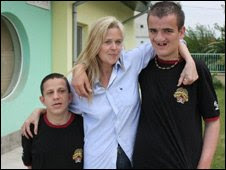
Above: Bulgaria has the highest number of disabled children in institutes in the EU. (Milen and Misho now live in a small home with other young people of mixed abilities.


Above: Didi now goes to school every day and is top of her maths class.


Above: Vasky was suffering from malnutrition and neglect but is now much happier.

The article:

New lives for Bulgaria's abandoned children

Award-winning documentary filmmaker Kate Blewett recently returned to Bulgaria to see how things have changed after the international outcry in response to her film Bulgaria's Abandoned Children.

In the original film, which I made two years ago, I focused on a handful of the 75 disabled children living in the Mogilino institute and watched their lives over a nine-month period. I witnessed their dreadful deterioration.

My first impressions of Mogilino were strangely misleading because the actual building was clean, bleached and painted.

It was not until I pulled back the bed covers to witness the children's wasted bodies that I realised there was a very serious problem.

Vasky is blind and suffers with cerebral palsy. She was abandoned in a baby unit and then sent to Mogilino at the age of four, where she grew up. We learnt that when she arrived she loved music, and loved to dance and sing.

Sadly what I witnessed, 14 years after her arrival, was a deeply unhappy girl, who had simply shut down, who sat on her bed day in and day out — saying nothing, her head bent down between her knees.

Brutalised

Milen, a gentle teenager with a cleft palate and the mentality of a young child, is mute and spent each day helping out around the home. Now 21, he does not speak because no-one has bothered to talk to him.

During filming, Milen was brutalised and beaten by a member of the staff. I captured this on camera and confronted the director of Mogilino.

The offending staff member was fired and Milen was moved to a protected home far away.

Didi, now 20, arrived at Mogilino just before filming began. Her mother could no longer cope with her teenage daughter's autism at home, so she abandoned her to the institute.

Sadly for Didi, she was thrown into an environment where she could not make any friends or continue with her education, because Mogilino is a place for the uneducable and those living there do not speak.

Didi deteriorated rapidly and would rock back and forth relentlessly. She shut down — just like all the others around her.

Extraordinary impact

To witness such human deterioration and to know the only way to truly effect change was to carry on filming and bring the documentary film to a wider audience — was an incredibly difficult process.

However the impact my film had has been extraordinary. Viewers wrote to me by the thousands, donating money, and forming petitions demanding change from their MPs and MEPs.

Some gave up their jobs and went to Bulgaria to help, taking supplies, food, clothing and medical aid.

The Bulgarian government put Unicef in charge of finding new placements for all the children of Mogilino, with the plan that the institute will shut once every child has been re-housed.

Slavka Kukova, co-ordinator of the Protection of the Institutionalised Children's Human Rights Program, says that the film meant that disabled children's "rights and problems are now on the agenda for the Bulgaria media."

"A slow process of raising awareness about the potential reform of the children care system has now started," she adds.

This year I returned to Bulgaria to find out exactly what has happened to some of the key characters from the original film. Once again I was shocked by what I found.

I witnessed the miraculous improvements that can happen in badly-damaged children when decent care is finally given to them.

Milen now lives in a glorious home with seven other young people and good carers. He is a new person — happy, outgoing and communicative through sign language.

He works every day putting handles onto bags and is paid for the amount he completes. He attends a day-care centre where he creates art and plays games with the other young people.

Genuine care

Didi lives in a special boarding school for those with behavioural and learning difficulties. She has wonderful carers and has made good friends.

She goes to school every day and is top of her maths class.

She makes her own clothes, goes to the shops to buy things she likes and visits museums and art galleries.

Vasky has been moved to an institute for the blind, which though large has excellent care and she has been transformed into a happy, active, smiling young lady.

She eats well and demands two courses at meal times, giggling cheekily with her carer as she asks if she can go out in her car with her.

A report from Unicef also recognised that the children from Mogilino have made great improvements since leaving the home.

"Their cognitive development has changed at all levels (perception, attention, memory and thinking) ... they have become part of particular groups and spend more time playing."

I feel overwhelmed with the dramatic changes in the lives of these young people. I feel the film lifted the lid on a desperate situation that had been hidden away.

I look forward to the day this year when Mogilino is finally shut.

The problems were not all about poverty or money, but rather about having a good level of genuine care that transformed a miserable existence into a fulfilling one.

Bulgaria does have good carers and decent homes but what it now needs to do is to get rid of its large, isolated institutes that are warehouses to a further 8,000 disabled children, and to create small group homes.

"There can be no more remodelling or restructuring of institutions. There needs to be a well-organised campaign that seeks to close down all institutions and set up proper alternative care services," says Mark O'Sullivan of the Bulgarian-based Cedar Foundation.

"The government needs to carry on what it is doing well but it also needs to radically overhaul the parts of its system which are not working," he adds.

All members of the EU should draw Bulgaria in as a new family member and help turn around the care system for the abandoned disabled children, to deinstitutionalise a country that has a new receptive government in place — and is ready for change.

Bulgaria's Abandoned Children Revisited is on BBC Four on Thursday 15 October at 2100 BST.

"The state acknowledged that the home in Mogilino did not meet care standards", article in Mediapool News, from March 5, 2008

Source:

"Държавата призна, че домът в Могилино не отговаря на стандартите за грижи", article in Mediapool News, 5 March 2008


The article:

Държавата призна, че домът в Могилино не отговаря на стандартите за грижи
05 март 2008

Проверка в дома за деца с умствени и физически увреждания в русенското село Могилино, извършена от служители на Държавната агенция за младежта и спорта (ДАМС) по нареждане на Върховната касационна прокуратура (ВКП), е установила, че домът отговаря само на един от 26-те стандарта за отглеждане на такива деца. Това съобщи началникът на дирекция Бистра Петрова пред парламентарната комисия по въпросите за децата, младежта и спорта.

Така държавата призна, че грижите в дома, добил скандална известност не само у нас, но и в Европа покрай филма на ББС “Отхвърлените деца на България”, не отговарят на съвременните изисквания. Преди това обаче всички възможни държавни институции хвърлиха огромни усилия да опровергават авторите на филма, който показваше как децата в този дом влошават състоянието си именно от липсата на адекватно отглеждане.

Проверката е завършила с категоричното становище, че домът в Могилино трябва да се закрие заедно с останалите 6 подобни заведения.

Оттук насетне заседанието на парламентарната комисия зацикли в познати тези о неефективни решения. Така председателят на комисията Васил Иванов — Лучано предложи да бъде сформирана междуведомствена контактна група, която да работи по дейността на всички социални домове в страната. Според предложението му в групата ще влязат представители на Министерството на правосъдието, на финансите, на труда и социалната политика, на образованието, на здравеопазването, на Държавната агенция за закрила на детето, Агенцията за социално подпомагане, Националното сдружение на общините, както и на Държавната агенция за младежта и спорта. Гласуването на това предположение обаче остана за следващото заседание на комисията.

Директорката на дома Павлина Йорданова обяви пред депутатите, че извършеният медицински преглед на децата е показал, че част от тях не биха могли да се адаптират, ако бъдат изведени от досегашната им среда. Тя призова поне някои от децата да останат за отглеждане в дома, и ако се налага, той да бъде преобразуван в "малък групов дом".

Кметът на село Могилино Димитър Димитров заяви пред комисията, че материална база в дома отговаряла на всички изисквания. Кметът повтори пред журналисти страха си, че 60-те души от селото, които за заети в дома, ще останат без работа.

Секретарят на община Русе Валентин Христов пък помоли депутатите да не прибързват със затварянето на дома в Могилино и с преместването на децата в община Русе, защото това щяло да бъде само "географско решение на проблема, който касаел предимно тяхното обгрижване."

Община Русе била готова за предостави терен, но напрежението в квартал "Средна кула" избухнало именно заради прибързаното обявяване закриването на дома, каза още Христов. По думите му, едно евентуално преместване на децата от Могилино в община Русе ще бъде вредно за тях заради враждебната среда, в която ще попаднат. А от квартала някои хора реагираха на новината за евентуално преместване на увредените деца в защитени жилища с довода, че питомците щели да стресират техните деца.

English translation (my own):

The state acknowledged that the home in Mogilino did not meet care standards
March 05, 2008

An inspection of the home for children with mental and physical disabilities in the Ruse village of Mogilino, carried out by employees of the State Agency for Youth and Sports (SAYS) on the orders of the Supreme Cassation Prosecutor's Office (SCP), found that the home met only one of the 26 standards of caring for such children. This was announced by the head of the directorate Bistra Petrova before the parliamentary committee on children, youth and sports.

Thus, the state acknowledged that the care at the home, which gained notoriety not only in our country but also in Europe along with the BBC film "Bulgaria's Abandoned Children", does not meet modern requirements. Before that, however, all possible state institutions made great efforts to refute the authors of the film, which showed how the children in this home worsen in their condition precisely because of the lack of adequate care.

The inspection ended with the categorical opinion that the home in Mogilino should be closed together, with 6 other similar establishments.

Henceforth, the sitting of the parliamentary committee became entrenched in ineffective decisions. Thus, the chairman of the commission, Vasil Ivanov-Luciano, proposed to form an interdepartmental contact group to work on the activities of all social homes in the country. According to his proposal, the group will include representatives of the Ministry of Justice, Finance, Labour and Social Policy, Education, Health, the State Agency for Child Protection, the Social Assistance Agency, the National Association of Municipalities and the State Agency for Youth and Sports. However, the vote on this assumption remained for the next committee meeting.

The director of the home, Pavlina Yordanova, told the deputies that the medical examination of the children showed that some of them could not adapt if they were taken out of their current environment. She called for at least some of the children to stay in the home and, if necessary, it be converted into a "small group home".

The mayor of the village of Mogilino, Dimitar Dimitrov, told the commission that the material base in the home met all the requirements. The mayor reiterated to journalists his fear that the 60 people from the village who are employed in the home will lose their jobs.

The secretary of the municipality of Ruse, Valentin Hristov, asked the deputies not to rush with the closing of the home in Mogilino and the relocation of the children in the municipality of Ruse, because this would be only "a geographical solution to the problem, which mainly concerned their care."

The municipality of Ruse was ready to provide land, but the tension in the Sredna Kula neighborhood erupted precisely because of the hasty announcement of the closure of the home, Hristov added. According to him, a possible relocation of the children from Mogilino to the municipality of Ruse will be harmful for them because of the hostile environment in which they will find themselves. And some people in the neighborhood reacted to the news of the possible relocation of disabled children to sheltered housing, arguing that the little ones would stress their children.

"Bulgaria: Orphans Suffer Dire Neglect", article in Radio Free Europe/Radio Liberty News, November 9, 1997

Source: Bulgaria: Orphans Suffer Dire Neglect , article written by Anthony Georgieff for Radio Free Europe/Radio Liberty News, 9 November, 1...